
How Do You Know Payroll is Correct Today? Can You Prove It?
5 minute read
How do you demonstrate payroll is correct today?
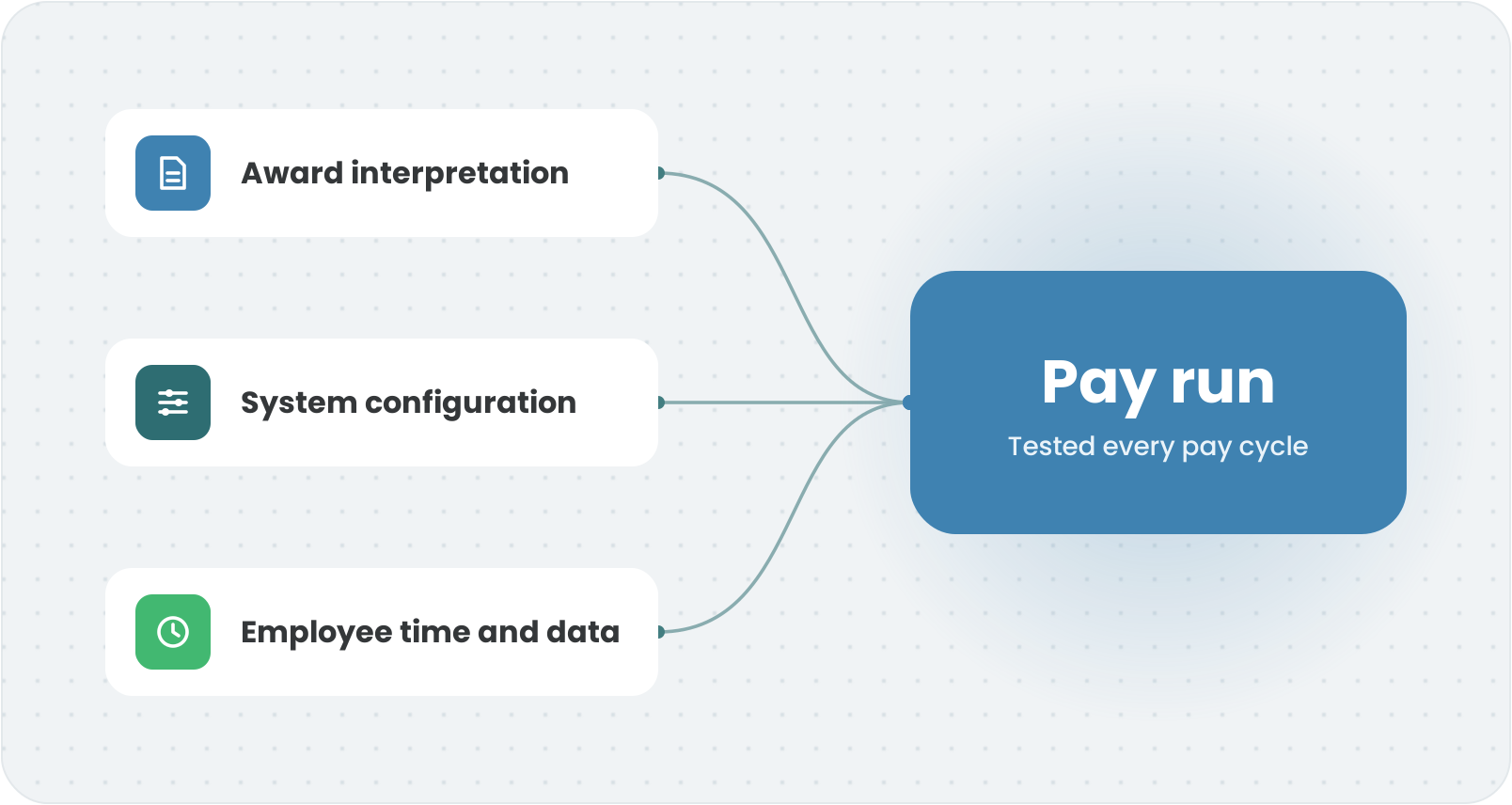
You can only be truly confident payroll is correct today if every employee’s pay is tested for every pay run. That means checking it against the applicable Modern Award or enterprise agreement before the pay run is finalised. This requires assurance over the actual employee entitlements and payroll outputs, not just the payroll process alone.
WageSafe’s audit results rarely show errors that come simply from the interpretation of complex awards. They happen when the award, the system set-up and the employee data don’t work together as they should to achieve the desired outcome.
These elements only come together in the pay run, so that is where payroll outcomes need to be tested.
It’s the core idea behind real-time wage compliance: assurance every pay cycle, not at a point in time with a sample-based audit or review.
Why aren’t reconciliations enough?
Reconciliations, variance reports and sign-offs are worth keeping. But as The Payroll Blind Spot by Tracy Angwin asks, what do they actually prove? A reconciliation shows totals balance, and a variance report shows what changed. Neither shows that each employee was paid what their Modern Award or enterprise agreement requires.
Across more than 1 million payroll audits, WageSafe always finds discrepancies, including in organisations with strong process controls. The answer is to extend existing controls so they check outcomes too.
Complex awards aren’t the problem
It’s natural to assume complex awards carry the most risk. Our audit data says otherwise.
The deciding factor is whether the systems in place can correctly process the organisation’s actual data: real hours, changing rosters, rotating shift patterns and ad hoc shifts.
Pay is only right when three things are correct and working together: the interpretation of the relevant industrial instrument, the configuration of time and payroll systems, and the accuracy of employee and time data. Each can pass a check on its own. The errors appear when all of this comes together in the reality of what occurs during the pay period, at the time of payroll. A periodic review checks the parts; an independent audit of every employee, every pay cycle tests how all these elements come together, focusing on what matters most – the employee’s pay.
Penalties and overtime: the hotspots
Variances in penalties and overtime are among the most common we find in our analysis, in two recurring patterns:
- Work outside rostered hours. When someone starts early, stays late or picks up a shift, systems need to compare against the roster, not just interpret the standard hours worked.
- Late-night penalties. Where a higher rate starts at a set time, such as 10pm, errors cluster around shifts that cross the threshold, including across midnight and across pay periods.
The award rule is simple in both cases. A system can pay a standard rostered shift perfectly and still underpay the employee who stayed until 10:45pm or worked past midnight.
Why this matters now
Underpayments haven’t gone away. In November 2026, one of Australia’s largest employers agreed to back-pay around $169 million to 66,000 current and former employees under an enforceable undertaking with the Fair Work Ombudsman. The errors went back more than a decade and came from how enterprise agreements were applied, record-keeping problems and outdated payroll technology carried across systems.
It’s the pattern this article describes: the errors arose where the agreement, the system and the employee data meet, not in any one of them alone. And it happened in a large organisation with significant resources.
Team size and resources don’t prevent underpayments. Auditing every employee, every pay run catches potential issues when it matters most and gives organisations the opportunity to resolve them as close to the relevant pay run as possible, avoiding risk accumulation over time.
How to audit every pay cycle
- Before the pay run: validate changes since the last cycle, such as new rates, new employees, roster changes and system updates.
- During the pay run: reconcile actual pay results against the calculated entitlements of the relevant industrial instrument, based on the actual timesheets worked and approved. Real-time compliance tools like WageSafe do this automatically, independently calculating entitlements for every employee and comparing them with what they are going to be paid, or have been paid, depending on when the review runs.
- Before finalising: fix one-off exceptions and trace repeat patterns to interpretation, configuration or data.
- After the pay run: record what was tested, found and fixed.
- Recurring basis: review exception trends, revalidate interpretations and report to the executive.
Keep this evidence for each dimension:
| Dimension | Evidence | How often |
|---|---|---|
| Interpretation | Documented interpretation, review date | Quarterly, and when awards change |
| Configuration | Change log, tests on real data | Every change and pay cycle |
| Execution | Full-population pay-run results | Every pay cycle |
| Exceptions | Exception log, root causes | Every pay cycle |
| Governance | Named owner, executive reports | Quarterly |
Source: adapted from The Payroll Blind Spot by Tracy Angwin.
Where to begin
The Payroll Blind Spot offers three questions to test your framework:
Who owns payroll confidence?
How do we know payroll is right today?
What would alert us early if it wasn’t?
Start wherever the answer is least certain.
Frequently Asked Questions
What payroll controls should run every pay cycle? Validating changes since the last cycle, testing actual pay processed against the calculated award or agreement entitlements based on actual hours worked, resolving exceptions before finalising, and recording the results.
How often should payroll be checked for award compliance in Australia? Every pay cycle, with a broader quarterly review. Awards, rosters and employee data change constantly, so periodic audits leave long gaps.
Do more complex awards cause more payroll errors? Not in WageSafe’s experience. Across more than 1 million audits, the bigger factor is whether the time and payroll system can correctly process actual employee data against the relevant industrial instrument.
What are the most common payroll errors in Australia? Penalty and overtime errors are among the most common WageSafe finds, especially for hours worked outside the roster and shifts crossing a late-night threshold such as 10pm.
Why do T&A and payroll systems underpay penalty rates? Usually because they incorrectly base the interpretation of the award on the wrong hours (roster vs actual) or mishandle shifts that cross a penalty threshold.
Do real-time compliance tools replace existing payroll controls? No. They add entitlement and pay outcome testing to every pay run, alongside reconciliations, sign-offs and periodic independent reviews.
Further Reading from WageSafe
- Where AI Belongs in Payroll (and Where It Doesn’t)
- What Does “Independent” Actually Mean in Payroll Assurance?
- Your Enterprise Agreement Passed the BOOT Last Year. Does It Still?
- Payday Super: Why the Grace Period Isn’t a Free Pass
- Wage Compliance for CHROs: Why Pay Accuracy Is Now a Trust, Governance and Employer Brand Issue
About WageSafe
WageSafe is Australia’s first real-time wage compliance technology provider, delivering continuous wage assurance across every employee and every pay cycle. Our platform independently validates payroll outcomes against Modern Awards, Enterprise Agreements and Fair Work obligations. Learn more at wagesafe.com.au
