
Where AI Belongs in Payroll
(and Where It Doesn’t)
5 minute read
The short answer
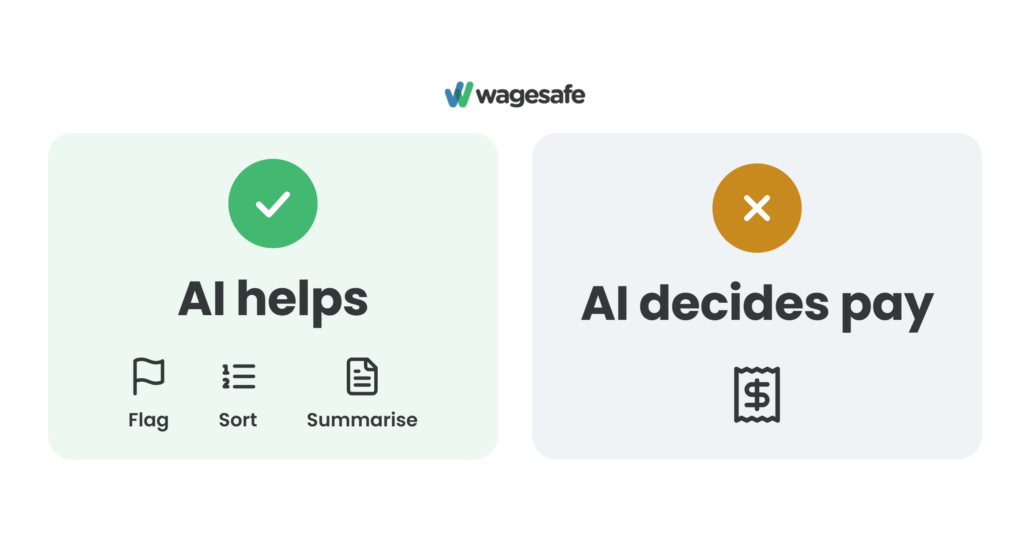
AI can make payroll teams faster, but it shouldn’t decide what an employee is owed. Under a Modern Award or Enterprise Agreement, each employee’s pay has one correct answer. It should come from rules that give the same result every time, and be checked independently before payday.
AI tools give the most likely answer, not a guaranteed one. Either way, the employer is accountable for what employees are paid.
Your payroll engine probably isn’t the problem
Most payroll systems in the Australian market don’t use AI to calculate pay. They run on rules: base rates, penalties, loadings, allowances and thresholds, set up for each award or agreement.
AI is arriving around the engine instead. It’s being used to:
- Interpret award clauses and turn them into pay rules
- Set up and map pay codes when a system is implemented or an award changes
- Classify employees and decide which award and level apply
- Answer managers’ and employees’ entitlement questions
- Help staff who paste a clause into a public AI tool and ask what to pay
A rules engine does exactly what it’s told. If an AI-assisted interpretation is wrong, the engine applies the wrong rule perfectly, to every affected employee, every pay cycle.
Why the question matters now
AI in payroll has moved from talk to use.
The Australian Payroll Association (APA) surveyed 467 payroll, HR and finance professionals. The share of organisations with no AI adoption fell from 49% to 36.7% in a year. Executive leadership is now the group most often driving AI adoption in payroll (37.7%), ahead of payroll teams (25.4%).
Two findings stand out. 49.7% of respondents see pay calculations and award interpretation as a task AI is well suited to improve, yet 40.2% don’t feel prepared to evaluate an AI-enabled payroll solution. And close to one in four workplaces report staff using public AI tools for payroll work without approval.
So AI is already influencing how awards get read, often outside any formal system. That raises a question boards and CFOs haven’t had to answer before: when AI shapes what employees are paid, how do you know the result is right?
Pay is deterministic. AI isn’t.
Working out an entitlement isn’t a judgement call. Given the hours, the classification and the instrument, there is one right amount. That calls for a method you can repeat and audit.
| Rules-based calculation | Generative AI | |
|---|---|---|
| Same inputs, same answer? | Always | Not guaranteed |
| Can show its working? | Yes, rule by rule | Gives an explanation, not a proof |
| How errors happen | A wrong rule, applied consistently | A plausible answer that’s wrong, sometimes inconsistently |
| Good for | Calculating entitlements | Drafting, summarising, spotting patterns |
“The AI told us” isn’t a defence for underpayment. An entitlement needs to be calculated by rules and verified against the instrument that creates it.
Where AI does help
AI is useful in payroll where a likely answer followed by a human check is good enough:
- Flagging unusual pay, hours or variances for review
- Sorting exceptions so people look at the riskiest first
- Summarising award changes for the team to action
- Explaining a payslip in plain language
These tasks make people faster without making AI the final word on what someone is owed.
The governance gap is already open
46.6% of organisations have no AI policy or governance framework for payroll, and only 1.1% have one specific to payroll.
Every organisation needs a policy. But a policy governs how AI should be used. It can’t tell you whether the pay that came out was correct. That takes a check on the outcome itself.
Vendor assurance is not independent oversight
68.7% of respondents don’t know whether their payroll software provider holds independent AI governance certification, such as ISO/IEC 42001. It’s worth asking: certification shows the vendor manages its AI responsibly.
It doesn’t show that your employees were paid correctly under your award, your agreement and your rosters. It also doesn’t cover how your system was configured, or the AI tools your own staff use.
What independent oversight looks like
Only 4.5% of APA respondents are comfortable giving AI high or full autonomy. The most popular model (42.1%) is AI handling routine work while people review the exceptions. That model only works if the exceptions are found reliably.
Independent payroll assurance should check:
- Separately from the payroll system. It doesn’t rely on the configuration, rules or AI that produced the pay, so the system isn’t marking its own homework.
- Against entitlements. The Modern Award, Enterprise Agreement and legislation that apply to each employee. It tests what each person was owed, not just whether a control step happened.
- Every employee, every pay cycle. Not a sample, and not once a year.
- Before payday. Errors are fixed before they’re paid, not found in a remediation program years later.
Across more than 1 million payroll audits, WageSafe finds non-compliance in the vast majority. Adding AI doesn’t remove that risk. It changes how errors are introduced, and how fast they spread.
This is how WageSafe works: a real-time, independent audit of every employee’s pay, every pay cycle, alongside your existing payroll system. (See our full explainer: What Does “Independent” Actually Mean in Payroll Assurance?)
Questions to ask before AI touches pay
For CFOs and boards
- Where is AI influencing pay today: interpretation, setup, classification or advice?
- Who owns AI’s outputs in our payroll control framework?
- If AI misreads an award, how quickly would we know?
- What evidence shows every employee was paid correctly last cycle?
For HR leaders and payroll managers
- Which payroll tasks is AI already doing, including through unapproved tools?
- Which pay rules were set up or changed with AI help, and who checked them against the award?
- What checks the final pay, and is that check separate from the system that produced it?
If the answer to “what checks the output?” is “the same system”, the organisation is carrying risk it can’t see.
Frequently Asked Questions
Does AI calculate pay in Australian payroll systems? Usually not. Most payroll engines calculate pay with configured rules. AI is more often used around the engine: interpreting awards, setting up pay rules, classifying employees and answering entitlement questions.
Does AI in payroll need independent oversight? Yes. The employer remains accountable for what employees are paid. Wherever AI influences pay, the result should be checked against legal entitlements, separately from the system that produced it, every pay cycle.
Should AI be used to work out award entitlements? It can help people find and summarise the relevant clauses. But an entitlement has one correct answer, so it should be calculated by rules and verified against the award or agreement, not left to an AI’s best guess.
Can AI interpret Modern Awards correctly? Often, but not reliably enough on its own. A wrong interpretation built into pay rules is then applied consistently to every affected employee. AI-assisted pay should be verified against entitlements before payday.
How many Australian organisations have an AI policy for payroll? Very few have a payroll-specific one. APA’s 2026 Payroll AI Adoption Report found 46.6% have no AI policy for payroll, and only 1.1% have one specific to payroll.
Is ISO/IEC 42001 certification enough to trust payroll AI? Not on its own. It shows a vendor manages its AI responsibly, not that your employees were paid correctly under your awards and agreements.
What is the difference between AI governance and independent payroll oversight? AI governance sets rules for how AI is used. Independent payroll oversight checks the result: whether each employee was paid what they were owed. Organisations need both.
Source: Australian Payroll Association, 2026 Payroll AI Adoption Report, supported by The Access Group. Based on 467 responses from payroll, HR and finance professionals across Australia, collected August to September 2026. WageSafe audit figures are drawn from WageSafe’s own audit data.
